Battery Voltage Reference Guide
This reference provides typical nominal, float, and boost voltages for the three main battery chemistries used in industrial standby power applications. All values are per cell.
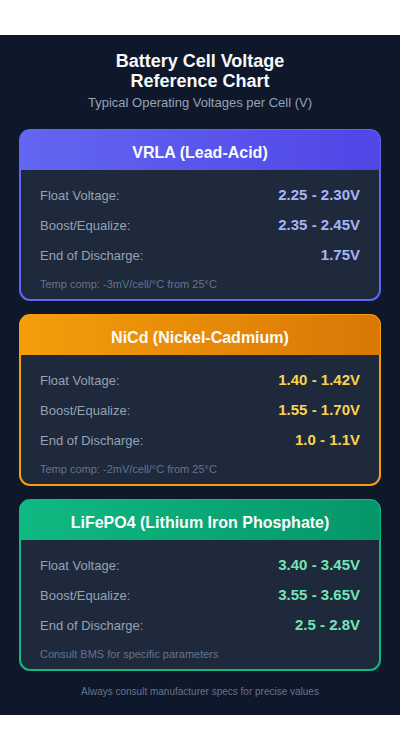
VRLA (Valve Regulated Lead-Acid)
Parameter | Voltage (V/cell) | Notes |
|---|---|---|
Nominal | 2.0 | Standard reference voltage |
Float | 2.25 - 2.30 | Continuous charge at 25°C |
Boost/Equalize | 2.35 - 2.40 | Periodic equalization charge |
End of Discharge | 1.75 | Minimum safe discharge level |
NiCd (Nickel Cadmium)
Parameter | Voltage (V/cell) | Notes |
|---|---|---|
Nominal | 1.2 | Standard reference voltage |
Float | 1.40 - 1.45 | Continuous trickle charge |
Boost | 1.55 - 1.65 | Fast recharge after discharge |
End of Discharge | 1.0 | Minimum safe discharge level |
LiFePO4 (Lithium Iron Phosphate)
Parameter | Voltage (V/cell) | Notes |
|---|---|---|
Nominal | 3.2 | Standard reference voltage |
Charge Voltage | 3.5 - 3.65 | CC/CV charging termination |
Storage Voltage | 3.2 - 3.3 | ~50% SOC for long-term storage |
End of Discharge | 2.5 | BMS cutoff voltage |
Key Considerations
When selecting or specifying batteries, consider:
- Operating temperature range affects voltage characteristics
- Manufacturer-specific values may vary slightly
- Float voltage is critical for maximizing battery life
- End-of-discharge voltage affects available capacity
Related Resources
For more detailed comparisons between battery technologies, see our article on LiFePO4 vs VRLA batteries.